Currently Empty: 0 $

Analysis: The Mechanics of Autonomous Real Estate
From “Smart” to “Self-Governing”
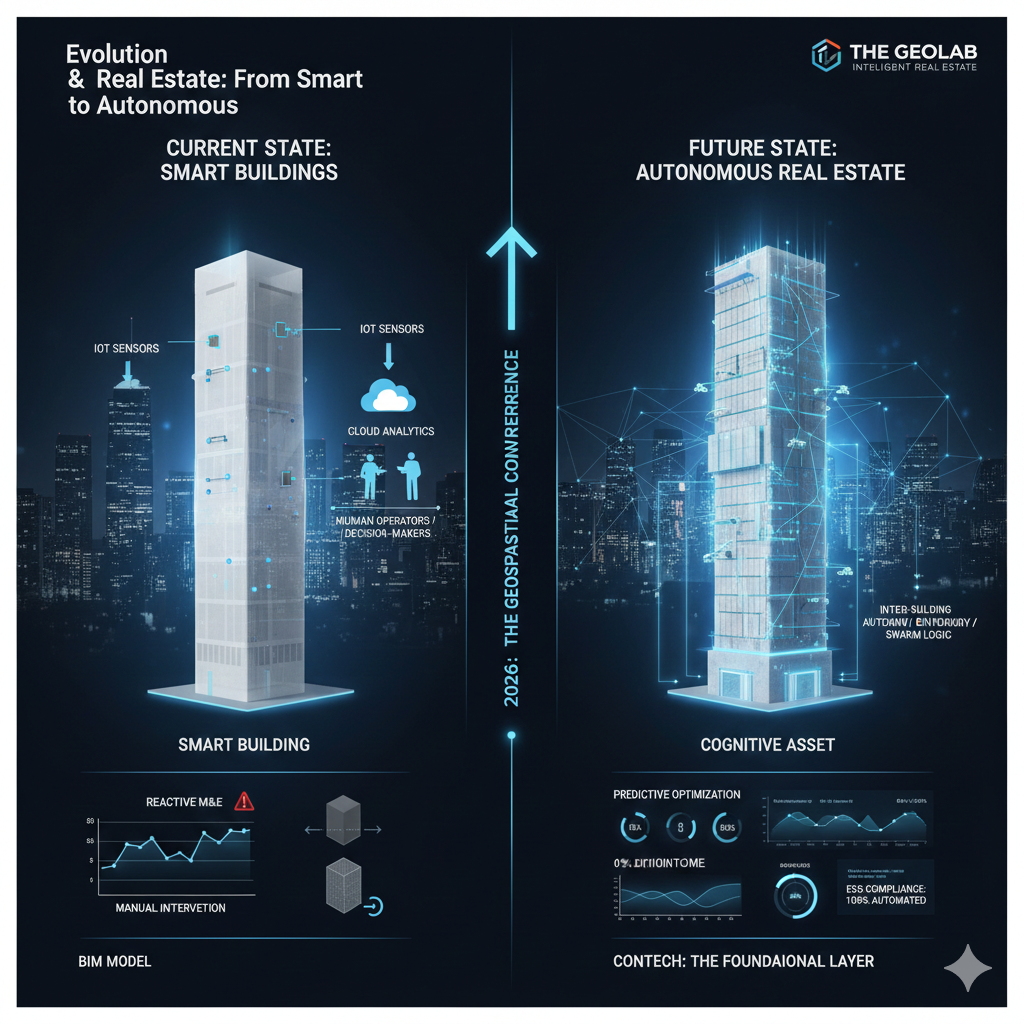
The industry currently operates at the “Smart Building” level: systems that capture data and present it to human operators for decision-making. Autonomous Real Estate represents the next phase—a closed-loop system where the asset captures data, analyzes it against geospatial context, and physically actuates a response without human intervention.
For this to occur, Contech must evolve from a tool for building into a tool for embedding intelligence.
1. The Physical Layer: Contech as “Cognitive Infrastructure”
Autonomy cannot be retrofitted; it must be cast into the concrete. The role of Contech is shifting from temporary site efficiency to the permanent embedding of the building’s nervous system.
-
Embedded Sensor Fabrics: Future construction will move beyond surface-mounted sensors. We are analyzing the rise of smart aggregates—concrete mixes embedded with conductive nanomaterials that provide real-time structural health monitoring (SHM). This allows the building to autonomously detect stress fractures or load anomalies mapped to specific geospatial coordinates.
-
The “As-Built” Digital Thread: Currently, the “Digital Twin” is often disconnected from the physical reality after handover. In an autonomous model, the Contech phase must generate a dynamic “Digital Thread” that persists. Construction robots don’t just build; they map the exact location of MEP (Mechanical, Electrical, Plumbing) systems behind walls to the millimeter. This geospatial precision allows future autonomous maintenance bots to access utilities without destructive exploration.
2. The Kinetic Layer: Actuated Building Envelopes
An autonomous building is not a static shell; it is a machine. Contech provides the mechanical capacity for the building to physically adapt to its geospatial environment.
-
Geospatial-Responsive Facades: We are moving toward kinetic architecture where building skins automatically adjust opacity, angle, and ventilation based on real-time solar pathing and local wind tunnel data. This isn’t just opening a window; it is a structural reconfiguration of the facade to minimize thermal load, driven by Contech engineering.
-
Robotic Maintenance Integration: Autonomous Real Estate requires “maintainability by design.” Contech architects are now analyzing elevator shafts and service voids not just for human access, but as highways for maintenance drones. The building is constructed with docking stations and charging pads integrated into the structure, allowing bots to repair leaks or clean solar panels based on weather patterns detected via GIS.
3. The Logic Layer: Spatial Edge Computing
For a building to act autonomously, latency is the enemy. It cannot wait for cloud processing to close a floodgate or balance a power spike.
-
Localized Context Awareness: The convergence of Contech and Proptech relies on Edge Computing. The building processes its own geospatial data (seismic activity, flash flood warnings, grid instability) locally.
-
Inter-Building Autonomy (Swarm Logic): This is the macro-level analysis. Autonomous buildings will communicate with neighboring assets. If Building A casts a shadow on Building B’s solar array (predicted via geospatial modeling), Building B autonomously lowers its energy consumption or draws from a shared battery storage unit. This requires a standardized data exchange protocol established during the construction phase.
The Economic Implication: CapEx vs. OpEx
The shift to Autonomous Real Estate fundamentally alters the financial analysis of development.
-
Higher CapEx (Contech): Upfront construction costs increase due to the installation of actuators, sensor fabrics, and edge computing infrastructure.
-
Lower OpEx (Proptech): The long-term operating costs plummet. The building self-optimizes energy usage, predicts its own maintenance failures before they become catastrophic, and reduces the need for on-site facility management staff.
Conclusion for The Geolab
At thegeolab, we posit that Autonomous Real Estate is the ultimate validation of geospatial data. A building can only be autonomous if it understands its context. By fusing the physical capabilities of Contech with the contextual intelligence of GIS, we are not just building better assets; we are creating organisms that live in symbiosis with the city.
Related Posts